Competitors
Competitors describe Accenture plc's market in their own filings and calls. These verified passages and visual pages show where their strategies meet, using source documents preserved in Sources.
IBM (IBM)
IBM Consulting is the closest large Western analogue to Accenture's technology-and-consulting model, names Accenture first among the competitors of its Consulting segment in its own 10-K, and is the only peer that publishes a cumulative generative-AI 'book of business' split between software and consulting - the nearest public comparator to Accenture's GenAI bookings disclosure.
IBM's stated cumulative generative-AI book of business at the end of 2025: over $12.5bn inception-to-date, of which more than $10.5bn sits in consulting rather than software. IBM's own framing is that the pairing of a technology stack with consulting at scale is the differentiator.
Arvind Krishna, Chairman, President and Chief Executive Officer: The breadth of our AI offerings is another key differentiator. Combining an innovative technology stack with consulting at scale, and our client zero journey. Our cumulative Gen AI book of business now stands at over $12.5 billion, of which software is more than $2 billion and consulting is more than $10.5 billion, with both seeing their largest quarterly increase to date.
p. 2 · Read in context →
IBM's stated GenAI penetration of its consulting business in Q1 2026 - about 40% of signings, 30% of backlog, over 20% of revenue and $4bn of ARR - plus its claim that 80% of the GenAI book comes from clients newly captured.
James Kavanaugh, Senior Vice President and Chief Financial Officer: Consulting. Consulting is about 40% of our signings, 30% of our backlog is GenAI now, over 20% of our revenue. And on an ARR revenue perspective, in the first quarter, we eclipsed $4 billion ARR. […] 80% of our GenAI book of business right now is coming from capture from net new clients overall.
p. 12 · Read in context →
Cognizant Technology Solutions (CTSH)
The US-listed peer whose service mix overlaps Accenture's most directly, and the one whose 10-K enumerates the fullest named list of direct competitors - Accenture at the head of it, alongside every other peer on this tab. Its calls are also where the share-shift question inside the IT services market gets asked most bluntly.
Cognizant's own definition of its competitive set in its FY2025 10-K. Accenture heads the named list of direct competitors, alongside every other peer featured on this tab, and the filing sets out the factors Cognizant believes decide these contests.
Cognizant Technology Solutions Corporation, Form 10-K (FY2025), Item 1 - Competition: The markets for our services are highly competitive, characterized by a large number of participants and subject to rapid change. Competitors may include systems integration firms, contract programming companies, application software companies, cloud computing service providers, traditional consulting firms, professional services groups of computer equipment companies, infrastructure management companies, outsourcing companies, boutique digital companies and clients' in-house technology resources, such as GCCs. Our direct competitors include, among others, Accenture, Atos, Capgemini, CGI, Deloitte Digital, DXC Technology, EPAM Systems, Genpact, HCL Technologies, IBM Consulting, Infosys Technologies, Tata Consultancy Services and Wipro. […] The principal competitive factors affecting the markets for our services include the provider’s reputation and experience, strategic advisory capabilities, digital and AI capabilities, performance and reliability, responsiveness to customer needs, financial stability, corporate governance and competitive pricing of services.
p. 18 · Read in context →
Cognizant's stated Q1 2026 bookings momentum - 21% growth, seven deals of $100m+ TCV and one above $500m - framed by management around its 'AI builder' positioning.
Ravi Kumar, Chief Executive Officer: I believe our work to become the world's permanent AI builder is resonating, demonstrated by our first quarter performance. […] Q1 bookings grew 21% year-over-year. We signed 7 large deals with TCV of $100 million or greater, including 1 mega deal valued at more than $500 million.
p. 1 · Read in context →
An analyst puts the share-shift question directly - bookings growing well ahead of the industry - and asks whether the share is being bought with margin. Cognizant's CEO answers both: the deals were 'properly priced', and he attributes the wins to a repeatable large-deal template, rising win rates and self-originated deals. The elision drops only the CEO's opening aside.
Amit Jawaharlaz Daryanani (analyst), and Ravi Kumar Singisetti, Chief Executive Officer: And then if you go back to the bookings growth, I think bookings were up like 18%. And clearly, the industry is not growing at that rate. So it's fair to assume that your folks are picking up a good better market share over here. I'm curious, what do you attribute the share gains to? And are these share gains coming at potentially a lower margin point, at least initially versus what you traditionally get? […] We have successfully won competitive deals that were properly priced, and we are confident we will meet our margin targets. Looking back, last year we secured 29 deals and the year before, 17, and now we have established a strong template that is helping us improve consistently. Our win rates have seen a notable increase, allowing us to source and originate new deals. For instance, we originated a $1 billion deal ourselves, demonstrating our agility in the market.
p. 11 · Read in context →
Capgemini (CAP.PA)
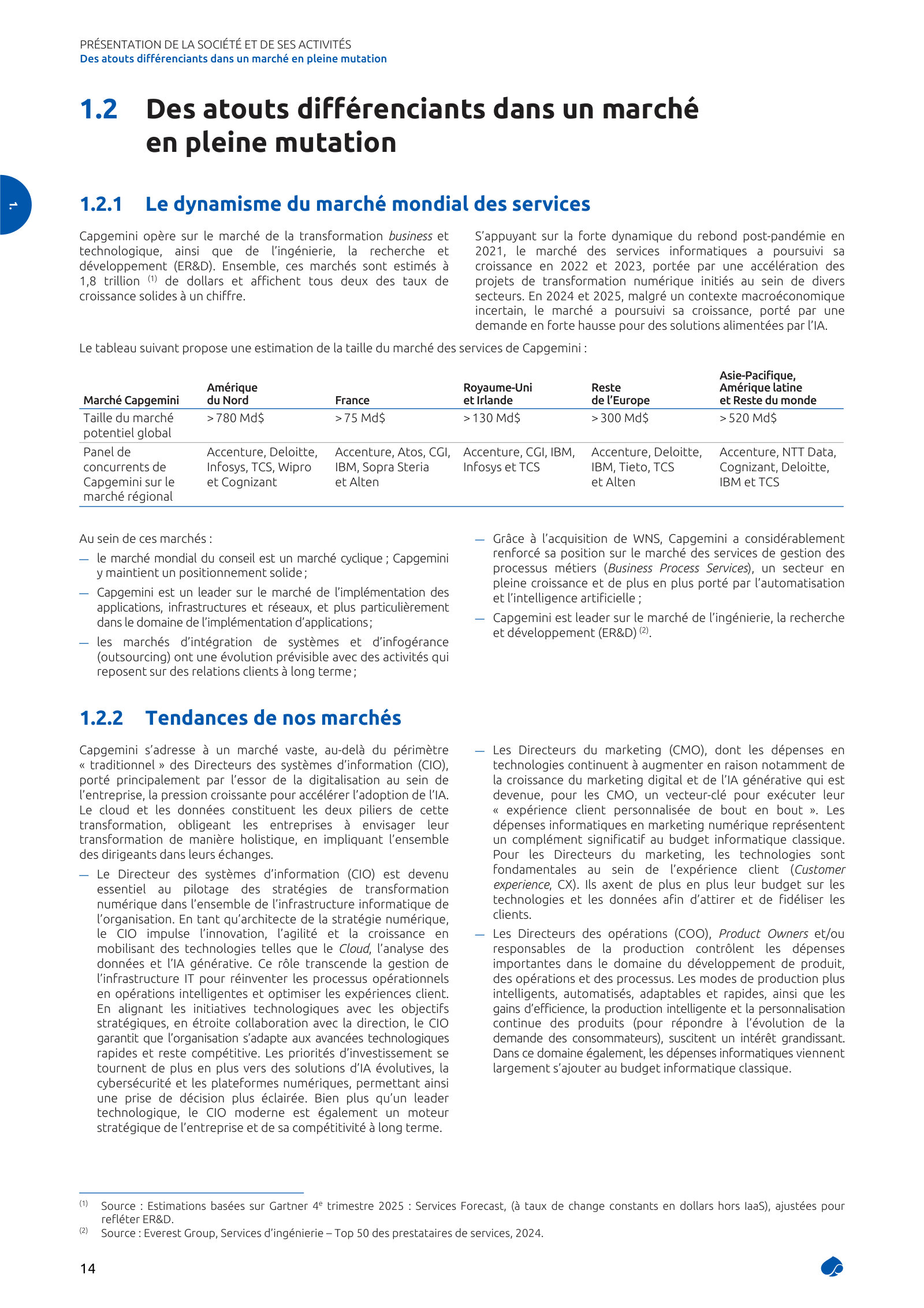
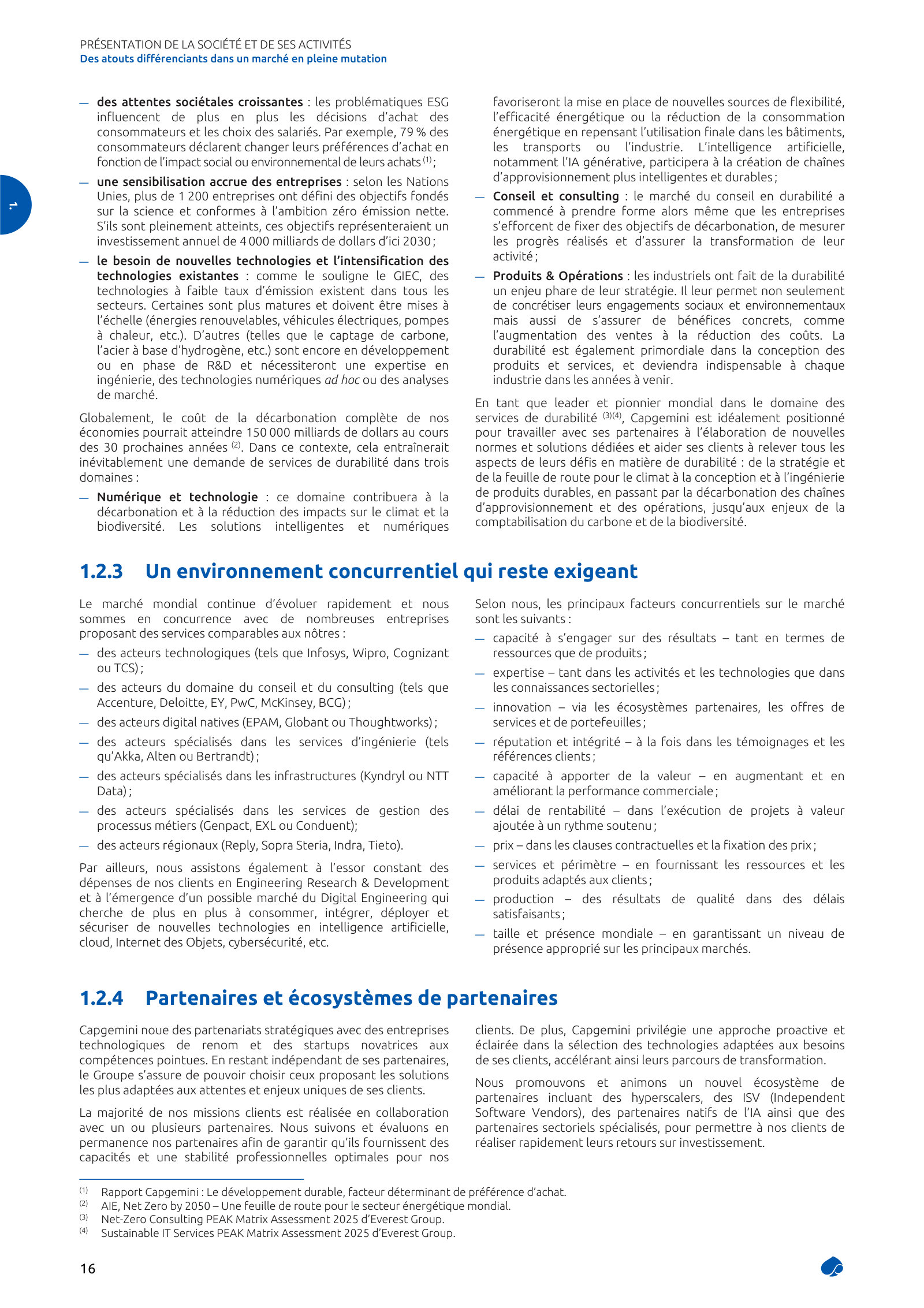
The European peer whose portfolio - strategy and consulting, technology, engineering/R&D and managed operations - maps most closely onto Accenture's, and which names Accenture as a competitor in every one of the five regional markets it reports. Its 2025 Universal Registration Document is published in French; both exhibits are page images of the market and competition sections.
Tata Consultancy Services (TCS)
The largest India-headquartered peer by revenue and headcount, and the one that has stated an explicit ambition to become the world's largest AI-led technology services company - a claim aimed at the position Accenture occupies. It is also taking the business into capital-intensive AI data centres, a direction Accenture has not followed.
TCS's stated Q1 FY27 (quarter to June 2026) order book of $9.5bn TCV and its disclosed AI services run-rate of $2.6bn annualised, growing 13.6% sequentially - the metrics TCS uses to argue it is converting AI demand. The elision drops three named deal bullets, the largest an $800m mega deal with SKF.
K Krithivasan, Chief Executive Officer and Managing Director: We delivered a TCV of $9.5 billion, including net new AI-led business transformation deals […] The third key takeaway is our AI services revenue continues to accelerate. At the end of Q1 FY27, it stands at $2.6 billion in annualized revenue, which is up 13.6% QoQ.
p. 3 · Read in context →
Infosys (INFY)
Competes with Accenture across the same large-deal, AI-transformation and managed-services pipeline, and is unusually explicit in public about two things Accenture investors care about: how big management thinks the AI services market is, and how much of AI-driven productivity gets handed back to clients in price.
A reporter anchors on the 5.5%-of-revenue AI figure Infosys gave at its Investor AI Day and asks what share it targets of the $300-400bn AI services market Infosys has cited for 2030; the CEO says Infosys is targeting 'a very good market share' of a number it sources to an external study, and declines to disclose the AI revenue behind it. Infosys's own sizing of the AI opportunity, on its own terms.
Ritu Singh, CNBC TV18, and Salil Parekh, Chief Executive Officer and Managing Director (Q4 FY26 media conference call): On AI, for instance, you told us in your investor briefing that 5.5% of the revenue in the third quarter came in from AI. The total addressable market is about $300-$400 bn. You know, in the fourth quarter, is there a number you could provide us, annualized what is the number you see? If there is more clarity you could give us, or what market share do you target from this $400 bn figure? […] So, we are targeting a very good market share from that number, which was for 2030 what we had given, the addressable market from an external study. The growth in AI services is very strong, but we have not disclosed that revenue number externally here.
p. 6 · Read in context →
The base figure behind that ambition: at its 2026 Investor AI Day, Infosys put the work inside its 'AI value framework' at 5.5% of revenue in Q3 FY26. It is a self-defined perimeter, not a reported segment, and the only AI revenue number Infosys has quantified publicly.
Salil Parekh, Chief Executive Officer and Managing Director (Investor AI Day 2026): So what I am showing you in the Hexagon in the AI value framework is not theoretical. These are things that are actually happening on the ground with Infosys. This is what we are executing. And this for us today represents 5.5% of our revenue in Q3, and it is growing at a robust pace.
p. 10 · Read in context →
An analyst asks why productivity gains hurt rather than help margin. Infosys's CFO answers that competitive intensity has risen and AI productivity is largely passed back to clients - the pricing mechanism that decides whether AI delivery gains stay with the vendor or are competed away. The elision drops only the speaker label.
Yogesh Aggarwal (analyst), and Jayesh Sanghrajka, Chief Financial Officer: And just a quick follow-up, you mentioned productivity pass-through impacted margins. I was just wondering why should that be the case, if there was productivity improvement? […] So Yogesh, market is competitive. As I said, the competitive intensity in the market has gone up and the productivity will get passed back to the client largely.
p. 32 · Read in context →
HCLTech (HCLTECH)
Overlaps Accenture in infrastructure and digital-workplace managed services, engineering/R&D and now AI transformation, and is the peer most willing to publish its own sizing of the shared market and to name AI-driven deflation as a structural threat to the headcount-based services model.
HCLTech's stated sizing of the market it shares with Accenture - roughly $1.5 trillion of enterprise IT services by 2028 at a 4.9% CAGR - set against its own statement that the headcount-led services model is at risk from AI.
HCLTech, FY2025 Annual Report - Management Discussion and Analysis: In the near term, the technology services sector may encounter some challenges due to uncertain macroeconomic conditions globally. But the outlook remains positive over the medium to long term as technology intensity increases across the entire global economy. The industry is adjusting to changes in discretionary spending as clients develop their AI investment plans. Although a short-term slowdown may occur, the total addressable market for enterprise IT services, which is the largest segment of enterprise technology spending, is forecasted to be approximately $1.5 trillion by 2028 with a CAGR of 4.9%. […] The traditional services business model, which relies on increasing staff to boost revenue, is at risk, being challenged by the rise of AI.
p. 127 · Read in context →
HCLTech's July 2026 framing of the market in three buckets - AI-native, AI-amplified and AI-disrupted - with a stated intent to outrun the deflationary curve in the disrupted part, and $171m of quarterly 'advanced AI' revenue growing 62.1% year on year.
C. Vijayakumar, Chief Executive Officer and Managing Director: We began FY27 with a focus to grow our advanced AI-led offerings, increase our relevance with clients, capitalize on the full range of AI-related market opportunities in our pursuit of becoming the world's best AI solutions provider.
As mentioned previously, our intent is very clear, benefit disproportionately from the AI-native and AI-amplified opportunities, which together represent the fastest-growing pool of enterprise spend, while in AI-disrupted services, we intend to innovate faster than the market to stay ahead of the deflationary curve rather than be defined by it. The fruition of this is reflected in our growing advanced AI revenue. Advanced AI revenue for the quarter stood at $171 million, marking 10.6% QoQ and 62.1% YoY growth.
p. 4 · Read in context →
More peer documents
Q3_FY2025 — 14 pages · Tracks the same GenAI book of business one year earlier at over $9.5bn inception-to-date, letting you build the accumulation curve IBM reports against Accenture's. · Open →
Q2_FY2026 — 12 pages · IBM's most recent read on where enterprise AI adoption stands ("clients remain in the early stages") and on consulting demand converting from it - the July 2026 update to the GenAI book quoted above. · Open →
CTSH_annual_report_FY2024 — 148 pages · Prior-year Cognizant 10-K carrying an identically worded competitor list; useful for confirming the named rival set is stable rather than newly drafted. · Open →
Q4_FY2025 — 14 pages · Cognizant's fullest discussion of pricing pressure and deal duration, the two variables behind ACV versus TCV divergence across the peer group. · Open →
CAP_annual_report_FY2024 — 67 pages · Capgemini's English-language consolidated accounts, with 2024 revenue by region and firm bookings of EUR 23,821m - the hard numbers behind the French market section. · Open →
TCS_annual_report_FY2026 — 361 pages · TCS's FY26 integrated report sets out the five-pillar 'Infrastructure to Intelligence' strategy and the vendor-consolidation demand thesis in management's own words. · Open →
INFY_annual_report_FY2026 — 384 pages · Infosys's FY26 MD&A and risk sections cover competitive landscape, win rates and vendor consolidation - the filing-level version of the call commentary quoted above. · Open →
HCLTECH_annual_report_FY2026 — 485 pages · Page 107 carries HCLTech's FY26 net new deal wins of $9.3bn TCV and its claim to be taking a significant share of a mid-market segment it sizes at over $400bn - the flank of the shared market rather than the large-enterprise core. · Open →