Annual Reports
Accenture plc's annual reports contain management's most considered account of the business. These are the sections, passages and visual pages worth opening in the originals preserved in Sources.
Accenture plc — FY2025 Annual Report (Form 10-K) — FY2025
First report on the new operating model: services folded into one Reinvention Services unit, segments recut into three markets. · Open the full document →
To our Shareholders — p. 3 · Read the full section →
Management's own read of the year: a market it calls persistently challenging, and the advantages it says it leaned on.
Julie Sweet on the fiscal 2025 market and the advantages the company says it built on.
In fiscal year 2025, Accenture delivered strong financial results and significantly elevated our competitive positioning, taking our next big steps to position us for growth in the age of AI. We built on the rapid shift we made in our business by the end of fiscal year 2024 to address challenging market conditions, which continue to persist. We then took action to fully capitalize on the competitive advantages we have built over a long period of time. […] These advantages include our ecosystem partnerships; our breadth of capabilities; our deep and trusted client relationships—we have partnered with 195 of our top 200 clients for 10 or more years; our track record of investing in new skills and rotating our business with successive technology revolutions; and our ability to invest. We know our clients and their industries inside and out, and, with these competitive advantages, we believe we can serve more of their needs for large-scale transformations than any other player in the industry.
p. 3 · Read in context →
Item 1. Business — Overview — p. 22 · Read the full section →
The business description in management's words: what Accenture sells, to whom, and the three axes it manages by.
How the company defines itself, its markets and its two types of work.
Accenture is a leading solutions and global professional services company that helps the world’s leading enterprises reinvent by building their digital core and unleashing the power of AI to create value at speed across the enterprise, bringing together the talent of our approximately 779,000 people, our proprietary assets and platforms, and deep ecosystem relationships. Our strategy is to be the reinvention partner of choice for our clients and to be the most AI-enabled, client-focused, great place to work in the world. […] We serve clients and manage our business through three geographic markets: Americas, EMEA (Europe, Middle East and Africa) and Asia Pacific. These markets bring together all of our Reinvention Services with both local and global talent and solutions. We go to market by industry, leveraging our deep expertise across our five industry groups— Communications, Media & Technology, Financial Services, Health & Public Service, Products and Resources. We deliver two types of work: Consulting and Managed Services.
p. 22 · Read in context →
Reinvention Services — p. 23 · Read the full section →
The structural change of the year — five separately described services collapsed into one business unit from September 1, 2025.
The September 1, 2025 consolidation of all services into a single integrated unit.
Effective September 1, 2025, we brought all of our services, which are described below, together into a single, integrated business unit called Reinvention Services. With this change, our client-focused growth model is bringing together all our capabilities across strategy, consulting, technology, operations, Song and Industry X, […] plus our technology ecosystem partnerships, to create more leading solutions faster and embed AI and data more easily into creating and delivering our solutions and services. […] With the majority of our large deals today already involving capabilities across multiple areas, the full rollout of our model is designed to make it faster and simpler to sell and deliver everything Accenture offers across our client base, while embedding more AI and data and equipping our people.
p. 23 · Read in context →
Industry Groups — p. 24 · Read the full section →
Where the revenue actually sits: five industry groups, their fiscal 2025 revenue and the sub-industry mix inside each.
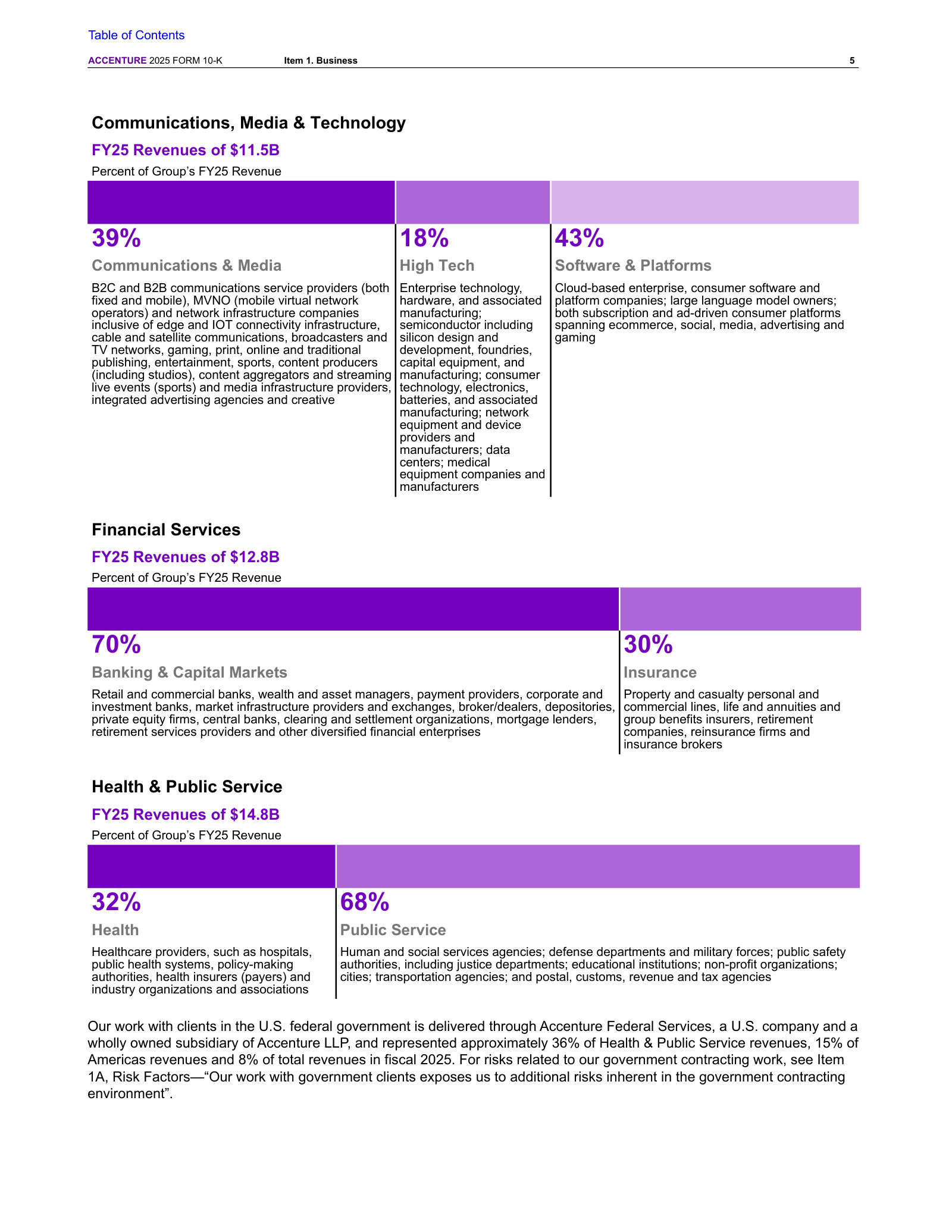
Size of the U.S. federal business, disclosed as a share of group, market and total revenues.
Our work with clients in the U.S. federal government is delivered through Accenture Federal Services, a U.S. company and a wholly owned subsidiary of Accenture LLP, and represented approximately 36% of Health & Public Service revenues, 15% of Americas revenues and 8% of total revenues in fiscal 2025.
p. 25 · Read in context →
People — p. 26 · Read the full section →
A 779,000-person workforce is the cost base; this is where the fiscal 2025 talent reset is stated in plain terms.
The refreshed three-pronged talent strategy, including exits on a compressed timeline.
We are implementing a refreshed three-pronged talent strategy to meet current and future client demand: investing in upskilling people, which has been and continues to be our primary focus; exiting people in a compressed timeline where reskilling is not a viable path for the skills we need; and identifying areas to drive even more operating efficiencies in our business, including through AI.
p. 26 · Read in context →
Item 1A. Risk Factors — Risks and uncertainties related to the development and use of AI — p. 32 · Read the full section →
The risk that AI substitutes for the billable work Accenture sells, written by the company that is also selling AI.
Item 1A. Risk Factors — If we do not successfully manage and develop our relationships with our ecosystem partners — p. 35 · Read the full section →
Accenture states that a very significant portion of its revenue rests on partners' technology — partners who also compete with it.
Dependence on ecosystem partners, and the ways that dependence can turn.
We have alliances with companies whose capabilities complement our own. A very significant portion of our revenue and solutions and services are based on technology, including platforms and software, provided by our ecosystem partners. […] The business that we conduct through these alliances could decrease or fail to grow for a variety of reasons. The priorities and objectives of our ecosystem partners may differ from ours. They offer solutions and services that compete with some of our solutions and services. They may also form closer or preferred arrangements with our competitors.
p. 35 · Read in context →
Item 1A. Risk Factors — Our work with government clients exposes us to additional risks inherent in the government contracting environment — p. 42 · Read the full section →
Pairs with the MD&A: the federal business is 8% of revenue and is being audited, repriced and terminated at the same time.
Audit and cost-recovery exposure on government contracts, including retroactive rate adjustments.
Government entities, particularly in the United States, often reserve the right to audit our contract costs and conduct inquiries and investigations of our business practices and compliance with government contract requirements. U.S. government agencies, including the Defense Contract Audit Agency, routinely audit our contract costs, including allocated indirect costs, for compliance with the Cost Accounting Standards and the Federal Acquisition Regulation. These agencies also conduct reviews and investigations and make inquiries regarding our accounting, information technology and other systems in connection with our performance and business practices with respect to our government contracts. Negative findings from existing and future audits, investigations or inquiries, or failure to comply with applicable IT security, supply chain, or other requirements, could affect our future sales and profitability by preventing us, by operation of law or in practice, from receiving new government contracts for some period of time, or result in other adverse consequences described in the following paragraphs. In addition, if the U.S. government concludes that certain costs are not reimbursable, have not been properly determined or are based on outdated estimates of our work, then we will not be allowed to bill for such costs, may have to refund money that has already been paid to us or could be required to retroactively and prospectively adjust previously agreed to billing or pricing rates for our work.
p. 42 · Read in context →
Item 7. Management's Discussion and Analysis — Overview and Key Metrics — p. 51 · Read the full section →
Management names what is acting on results — an unchanged discretionary environment and cuts to U.S. federal spending.
Demand conditions and the stated effect of U.S. federal spending reductions on Accenture Federal Services.
Our results of operations are affected by economic conditions, including macroeconomic conditions, the overall inflationary environment, new and rapidly changing technologies, and levels of business confidence. We continue to see significant economic and geopolitical uncertainty in many markets around the world, which has impacted and may continue to impact our business. While the discretionary environment is unchanged, clients continue to prioritize large-scale transformations, which include becoming AI-ready. In addition, the U.S. administration is reducing federal spending and the size of the federal workforce under the guidance of the Department of Government Efficiency. We are seeing impacts from these efforts in our federal government business (“Accenture Federal Services, or AFS”), including delays in new procurements, reductions in price and contract scope, and contract terminations. These changes have had an adverse effect on AFS’s results and could in the future have a material impact on our results of operations or financial condition.
p. 51 · Read in context →
Why the $80.6 billion bookings number and the $34 billion of remaining performance obligations are not the same thing.
The majority of our contracts are terminable by the client on short notice with little or no termination penalties, and some without notice. Only the non-cancelable portion of these contracts is included in our remaining performance obligations disclosed in Note 2 (Revenues) to our Consolidated Financial Statements under Item 8, “Financial Statements and Supplementary Data.” Accordingly, a significant portion of what we consider contract bookings is not included in our remaining performance obligations.
p. 54 · Read in context →
Accenture plc — FY2024 Annual Report (Form 10-K) — FY2024
The edition just before the reset: five separately named services and the old North America / EMEA / Growth Markets segments. · Open the full document →
Our Strategy — p. 23 · Read the full section →
The prior strategy statement, organized around 360° value and a combination of five distinct services — the framing FY2025 replaces.
The fiscal 2024 growth strategy, built on 360° value and five separately named services.
The core of our growth strategy is to be our clients’ reinvention partner of choice, delivering 360° value to our clients, people, shareholders, partners and communities. Our strategy defines the areas in which we will drive growth, build differentiation and enable our clients to transform their organizations through technology, data and AI to create value every day. We aspire to be at the center of our clients’ business and help them reach new levels of performance and to set themselves apart as leaders in their industries. […] Our clients turn to us to help them drive reinvention with our unique combination of services across Strategy & Consulting, Technology, Operations, Industry X and Song. Our strategists and deep industry, functional, customer and technology consultants work hand-in-hand with our clients and across services to shape and deliver these reinventions.
p. 23 · Read in context →
More annual reports
Accenture plc — 360° Value Report 2025 — FY2025 · 69 pages · Companion to the FY2025 annual report, not an edition of it: the client, talent and sustainability data behind the 360° value language. · Open →
Accenture plc — FY2023 Annual Report (Form 10-K) — FY2023 · 119 pages · The year of the $3 billion generative-AI commitment and $2.5 billion of acquisitions, with strategy still framed as 360° value. · Open →
Accenture plc — FY2022 Annual Report (Form 10-K) — FY2022 · 99 pages · The 10-K on its own, before the shareholder letter was bound in; Song appears here as the renamed Interactive business. · Open →
Accenture plc — 2021 Irish Statutory Accounts (Directors' Report and Consolidated Financial Statements) — FY2021 · 102 pages · Not a 10-K but the Irish-law filing for the same year: parent-company statements and directors' disclosures the 10-K omits. · Open →